

This Black Friday, fraud teams at African retailers and payment providers will try to approve as many genuine orders as possible without letting fraud through with them. Rules that would normally flag a large basket or a first-time buyer will be relaxed, so good customers aren't declined on the biggest trading weekend of the year. Each of those decisions will turn on the familiar question of whether an order is fraud. This year, some orders will raise a question that comes first. Is the shopper a person at all?
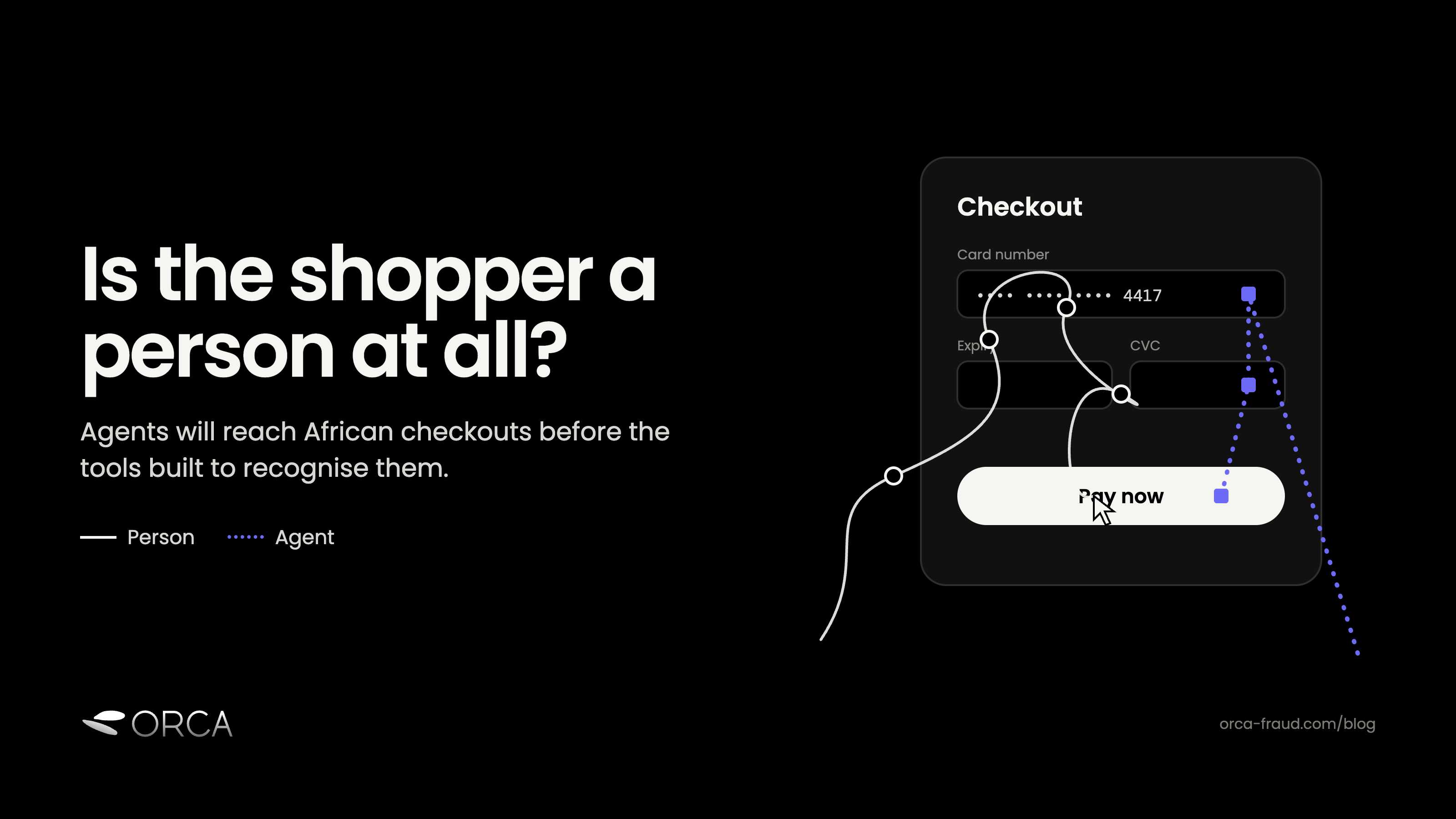
Until now, fraud teams have rarely needed to ask, and almost every control at checkout is built on the answer being yes. Device fingerprints, typing cadence, the path a cursor takes across a payment form, the seconds between landing on a product and paying for it. Much of what separates a rushed but genuine Black Friday shopper from a script is built on reading human behaviour under pressure.
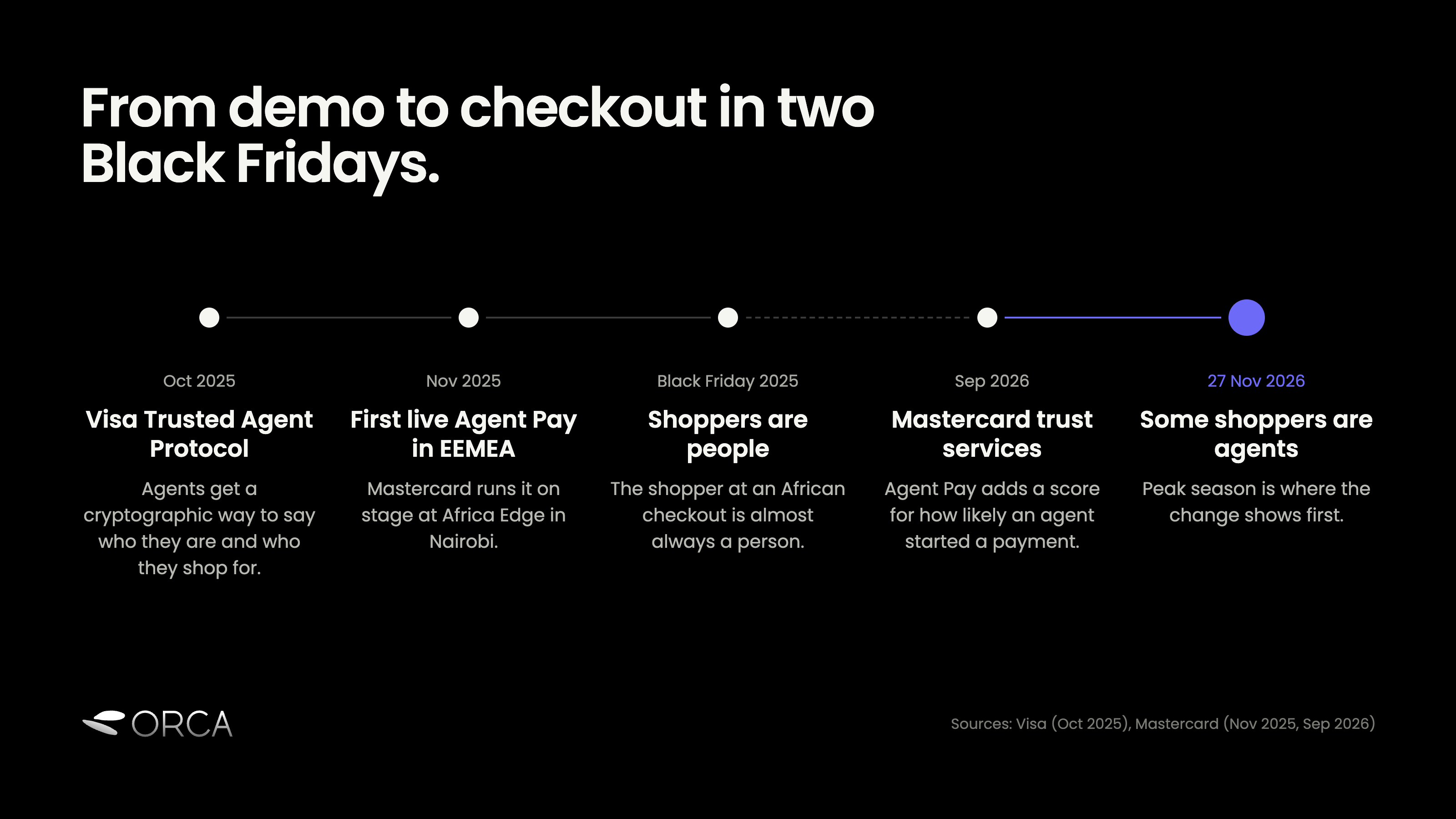
Since last Black Friday, that has started to change. AI assistants can now browse, build a basket and pay on a customer's behalf, and the card networks have built ways for them to do it. Last year, the shopper at an African checkout was almost always a person. This year, some will be an agent acting for one. By next November the balance may have shifted much further, and peak season is where the change will show first.
The agents are already at the till
Over the past year, the card networks have moved agentic commerce from demonstration to product. Visa released its Trusted Agent Protocol with Cloudflare in October 2025, giving AI agents a cryptographic way to tell a merchant who they are and who they are shopping for. At launch, Visa cited Adobe data showing AI-driven traffic to US retail sites had grown more than 4700% in a year. In September this year, Mastercard expanded Agent Pay with trust and intelligence services, starting with a score for how likely it is that an AI agent initiated a transaction.
The continent is part of this. Mastercard ran the first live Agent Pay transaction in Eastern Europe, the Middle East and Africa at its Africa Edge summit in Nairobi last November.
For fraud teams, the useful part is the set of questions these frameworks are built to answer. Each one tries to settle the same things at checkout:
- Is this an agent, or a bot posing as one?
- Is it acting for a real customer?
- Did that customer authorise this purchase?
Those are fraud questions before they are product questions, and most merchant controls on the continent were not designed to ask them.
Peak season compounds the problem
Black Friday is already the weekend when baselines are least reliable. In South Africa, Peach Payments processed more than R1.86 billion across the 2025 Black Friday weekend, up 93% in rand value on the year before. PayInc averaged 934 transactions a minute on the day itself, and Discovery Bank reported online card transactions 45% higher than on a typical last Friday of the month.
Fraud at peak does not rise in a straight line with that volume. Ten times the transactions can bring considerably more than ten times the fraud, because attackers know thresholds are looser and review queues are longer. Peak is also a window rather than a day. In South Africa, Black Friday falls against month-end payday, which stretches the high-risk period across the days on either side.
Add agents to that window. A legitimate agent doing a customer's shopping will look, to most controls, like a bot: no cursor movement, no hesitation, perfect form completion, a purchase in seconds. Automation run by a fraudster looks much the same. Block automation outright, and real customers are declined at the moment approval rates matter most. Loosen controls to let agents through, and card testing and account takeover come in alongside them.
Most teams already recalibrate for Black Friday traffic. Agent traffic asks them to recalibrate for a different kind of customer in the same weeks, with almost no history to calibrate against.

Most African payments won’t carry an agent’s ID
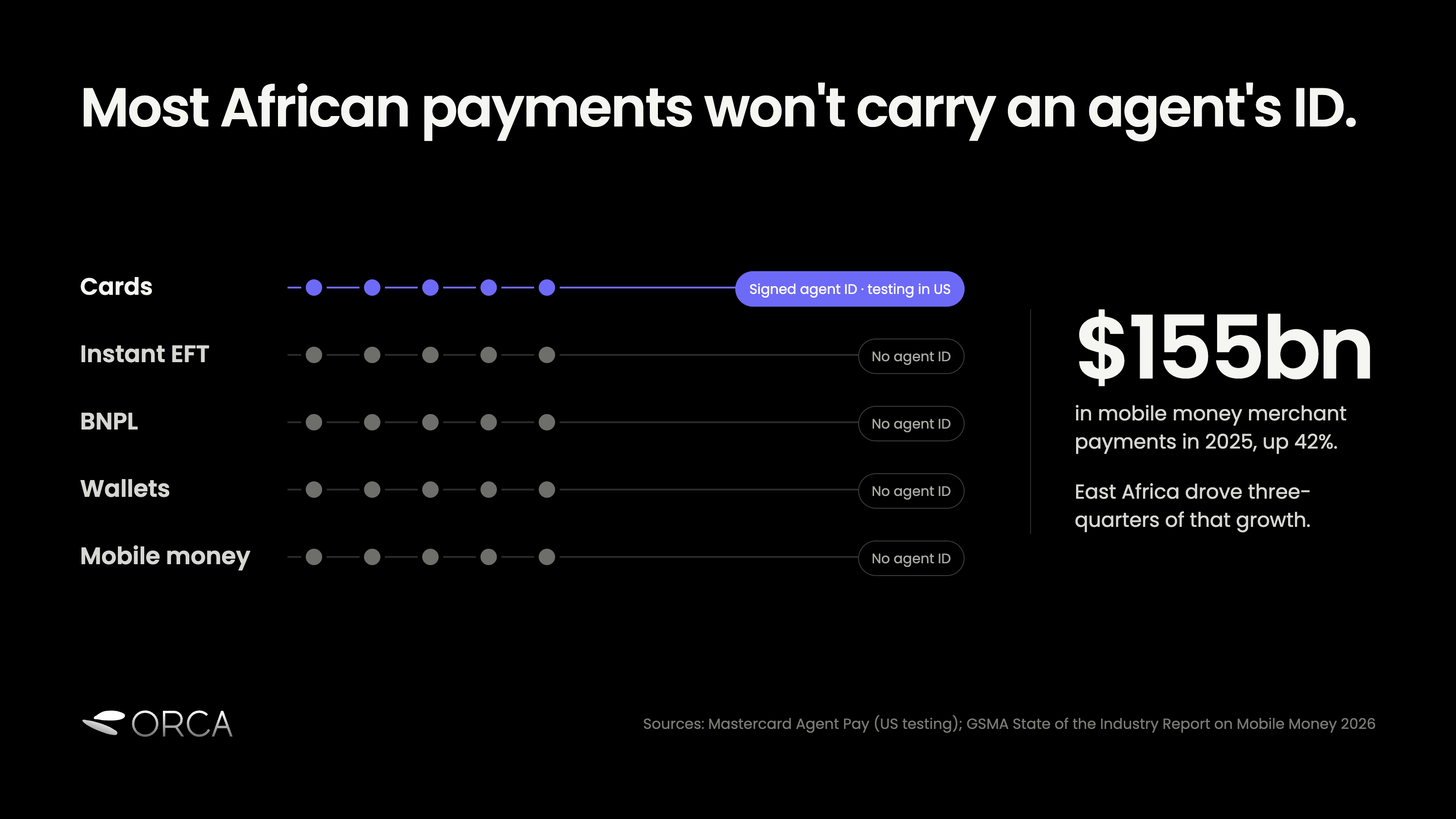
The network frameworks give an agent a way to identify itself at checkout, with a signed credential saying which agent it is, who it’s acting for and what it’s allowed to buy. That only works when the payment runs on a network that reads the credential. For now, that means cards, and Mastercard is testing its first agent signals in the United States.
Much of Africa doesn’t pay that way. In South Africa, instant EFT, buy-now-pay-later and wallets sit beside cards at checkout. In East and West Africa, mobile money carries a large share of everyday spending. GSMA reports that merchant payments through mobile money reached $155 billion in 2025, up 42%, with East Africa driving three-quarters of that growth.
On those rails, an agent arrives without a label, and so does a fraudster’s script pretending to be one. Telling them apart falls to the merchant and its payment providers, using only what they can see in the session and the transaction. When a customer later disputes what their agent bought, the record of what they approved sits in their conversation with the agent, which the merchant never sees.
It also leaves open who is behind an agent, and who pays when its purchase is disputed. No network rule yet settles liability when a customer disputes an agent's purchase for a reason other than fraud, so those disputes run through the existing chargeback process, where the merchant usually carries the loss. Each one also counts against the merchant. Visa's Acquirer Monitoring Program adds fraud reports and disputes into a single ratio, and in Central and Eastern Europe, the Middle East and Africa, a merchant is flagged as excessive at 2.2%. Acquirers are measured across their whole portfolio. A peak season of unrecognised agent purchases, and the disputes that follow weeks later, can push a merchant towards that threshold and add to its acquirer's count.
A small volume this year is an advantage
Agent traffic at African checkouts this Black Friday will be modest. That makes this the cheapest peak in which to learn what it looks like. The teams in the strongest position will be the ones that can already separate automated sessions from human ones at the device and behavioural level, then ask a second question of the automated ones: does this behave like a customer's agent, or like an attack?
Most of the signals are ones fraud teams already hold. Session speed, device consistency, whether a device has a history with this customer, whether the purchase fits the customer's pattern. What changes is the decision at the end of the signal, which can no longer default to blocking anything that isn't human. At Orca, where we monitor transactions in real time for banks, payment providers and retailers, the question we hear most from e-commerce teams going into peak is how to tell the automation they want from the automation they don't.

The networks will eventually give merchants a signed answer to whether an agent can be trusted. Until that answer reaches every rail, each institution will be working it out for itself, on the busiest weekend of its year. The question worth asking before 27 November is a simple one.
If an agent completed a purchase on your checkout last month, would anyone on your team know?